PERFECT SENSE
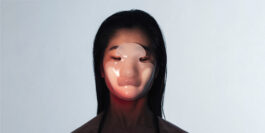
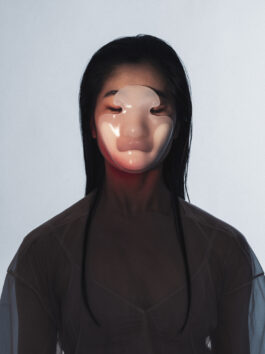
Perfect Sense is a series of object-masks exploring the phenomenon of sensory substitution: when the human brain loses access to a specific sense, it compensates for this loss by enhancing another sensory modality. By “disabling” a given sensory organ, other senses are sharpened to fill the gap, shifting perceptual priorities. These phenomena are referred to as semantic coupling and iconic coupling. The first describes situations in which changes in the perception of one sense can influence the understanding and interpretation of stimuli from other senses. The second refers to connections between senses, where one sensory impression evokes experiences in another sense.
The title "Perfect Sense" is borrowed from David Mackenzie’s film [2011], which depicts a mysterious epidemic that disables individual human senses. People try to adapt to the situation by intensifying sensory stimuli received through another modality – for example, the lack of taste is compensated by foods that produce sounds.
The project is inspired by 17th-century Venetian Moretta masks, which not only covered the face but were stabilized in place by biting a button, preventing speech and forcing the use of alternative communication methods.
Perfect Sense was developed using reverse engineering – the mask designs were modeled in 3D within virtual reality directly on a 3D head model. The masks consist of designed “bones” embedded in silicone “artificial skin,” colored in human skin tones and incorporating microplastic fibers meant to evoke associations with blood vessels in human skin. In addition to VR prototyping, 3D printing was used – for both the “bones” and the casting molds in which these bones were embedded.
The Perfect Sense masks present a futuristic, speculative vision of transforming the human face in pursuit of the titular “perfect sense.” The project addresses themes of transhumanism, questioning the limitations of the human body and the role of wearable objects as a form of sensory prostheses, using cross-sensory analogies.
KEY WORDS:
cross-sensory perception, sensory substitution, transhumanism, speculative design
CREDITS:
Photo: Mila Łapko
Masks designer: Iga Węglińska
Make-up artist: Anna Treder
Hair: Maciej Rybak
Model: Rena Miyamoto


PERFECT SENSE
Perfect Sense is a series of object-masks exploring the phenomenon of sensory substitution: when the human brain loses access to a specific sense, it compensates for this loss by enhancing another sensory modality. By “disabling” a given sensory organ, other senses are sharpened to fill the gap, shifting perceptual priorities. These phenomena are referred to as semantic coupling and iconic coupling. The first describes situations in which changes in the perception of one sense can influence the understanding and interpretation of stimuli from other senses. The second refers to connections between senses, where one sensory impression evokes experiences in another sense.
The title "Perfect Sense" is borrowed from David Mackenzie’s film [2011], which depicts a mysterious epidemic that disables individual human senses. People try to adapt to the situation by intensifying sensory stimuli received through another modality – for example, the lack of taste is compensated by foods that produce sounds.
The project is inspired by 17th-century Venetian Moretta masks, which not only covered the face but were stabilized in place by biting a button, preventing speech and forcing the use of alternative communication methods.
Perfect Sense was developed using reverse engineering – the mask designs were modeled in 3D within virtual reality directly on a 3D head model. The masks consist of designed “bones” embedded in silicone “artificial skin,” colored in human skin tones and incorporating microplastic fibers meant to evoke associations with blood vessels in human skin. In addition to VR prototyping, 3D printing was used – for both the “bones” and the casting molds in which these bones were embedded.
The Perfect Sense masks present a futuristic, speculative vision of transforming the human face in pursuit of the titular “perfect sense.” The project addresses themes of transhumanism, questioning the limitations of the human body and the role of wearable objects as a form of sensory prostheses, using cross-sensory analogies.
KEY WORDS:
cross-sensory perception, sensory substitution, transhumanism, speculative design
CREDITS:
Photo: Mila Łapko
Masks designer: Iga Węglińska
Make-up artist: Anna Treder
Hair: Maciej Rybak
Model: Rena Miyamoto